Aschenbach’s infatuation with Tadzio
Death in VeniceAschenbach’s infatuation with Tadzio becomes the emotional and moral center of his stay in Venice. What begins as the artist’s astonished response to a beautiful boy deepens into an attachment that shapes where Aschenbach goes, what he is willing to conceal, and how he understands his own loss of self-command. Its trajectory runs from an inwardly acknowledged reluctance to leave the Lido, through a smile that he experiences as a decisive gift, to secret pursuit and a willingness to remain in a city threatened by cholera. Tadzio’s importance to this story lies not in a reciprocal relationship, but in the way Aschenbach’s desire reorganizes his perception and conduct.
From Admiration to Attachment
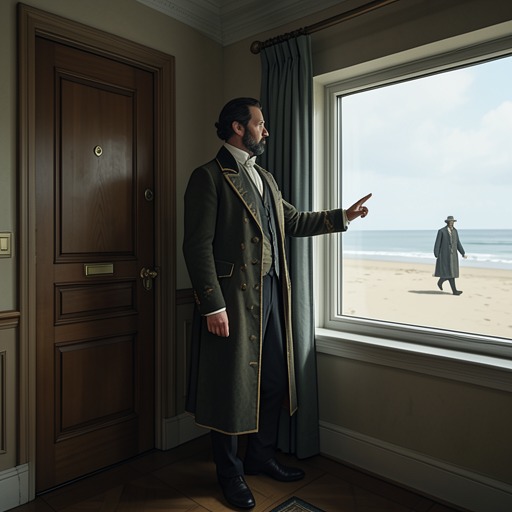
Aschenbach’s hesitation to leave the Lido is initially difficult for him to explain. When he sees Tadzio again from his room, the greeting he is about to form falls silent before what he recognizes as the truth of his feelings. He experiences pleasure and pain together, and understands that Tadzio has made departure difficult. His response is private and unobserved: he sits still, then raises his hands and turns his palms outward in a slow gesture of welcome. The movement marks an inward acceptance rather than any exchange between them. The boy has become a reason to stay, although Aschenbach has not yet openly admitted what that means.
The intensity of the attachment is sharpened by the circumstances in which Aschenbach first watches Tadzio. At the hotel, his careful routines and cultivated manner place him among guests assembled for dinner; on the beach, the spectacle of holiday life offers a sustained field for looking. Aschenbach follows the boy with an artist’s language of appraisal, trying to frame his delight as expert judgment. That aesthetic distance does not hold. When Tadzio later smiles at him, Aschenbach hurries away, overwhelmed, and finds refuge in the park. He understands the smile as a fatal gift, then gives a name to his own desire. The scene makes the change unmistakable: what could be contained as an evaluation of beauty has become an emotional confession, made to himself and not to Tadzio.
A Secret Made More Important Than Departure
The cholera outbreak changes the conditions of Aschenbach’s stay without diminishing his attachment. He learns that the city’s authorities are concealing the disease, while visitors begin to leave and the danger becomes increasingly difficult to ignore. Instead of treating this knowledge as a reason to go, he takes a dark satisfaction in the disorder surrounding him. The city’s secret becomes bound up with his own: he is implicated in keeping silent because he fears that Tadzio might leave. Aschenbach recognizes, with alarm, that he does not know how he could go on living if the boy were gone.
That fear alters the practical shape of his days. He no longer depends only on chance encounters or the hotel’s routines to see Tadzio; he follows him through Venice. When he suspects that the Polish family has gone to San Marco, he goes there and sees Tadzio at prayer. He then waits for the family to emerge and trails the group through the city, pausing or hiding when necessary, losing them and searching for them again. The pursuit is not a conversation or a courtship: Aschenbach remains at a distance, making the boy’s movements into the object of his own secret itinerary.
The following continues when Tadzio and his companions take a gondola. Aschenbach arranges for another gondola to follow, offering the rower a generous tip and asking him to keep his distance. He is relieved when the rower agrees to carry out the request. The episode shows how far the attachment has moved beyond involuntary looking: Aschenbach now recruits another person to help sustain his access to the boy, while the city’s narrow waterways and hidden routes become part of that pursuit.
Transgression and Self-Recognition
Aschenbach’s pursuit is accompanied by moments of moral awareness, but awareness does not restore his restraint. On returning late from Venice, he stops outside Tadzio’s room and cannot bring himself to leave at once, despite recognizing the danger of being discovered. At other moments he asks himself where his conduct is leading and imagines the judgment of his forbears, whom he associates with rigidity of principle and conventional masculinity. Yet he also recasts his own artistic life as a kind of prolonged struggle and self-conquest. This comparison does not resolve the conflict; it lets him interpret the force mastering him through the very language of discipline and heroism that once organized his self-image.
The contradiction grows starker as the outbreak worsens. By the time the hotel’s bathing houses and dining room are emptying, Aschenbach continues to watch Tadzio and to follow him through streets where the disease remains concealed. He imagines that flight and death might remove the other people around them, leaving him alone with the boy. In the moments when he is fixed on Tadzio, the danger and the moral limits that had troubled him seem to fall away. This is not a mutual bond or a promise of a shared future: it is Aschenbach’s increasingly self-enclosed fantasy, made more potent by the possibility that the object of his desire may depart.
Narrative Significance
The infatuation develops against the contrast between ordered appearance and concealed disorder. The Lido offers its guests an organized holiday world of hotels, dress, meals, and beach routines; Venice, with its carefully staged approach by sea, first appears to Aschenbach as a city suited to his desire for the foreign and the extraordinary. But the authorities’ concealment of cholera makes the city’s appearance of normality ethically consequential. Aschenbach’s private concealment echoes the public one: each allows an attractive surface to persist while danger is known and withheld.
The attachment also exposes the limits of Aschenbach’s artistic detachment. At first, he can treat Tadzio’s beauty as something to judge, comparing it to art; then the smile unsettles that stance, and his attention becomes a motive for remaining, hiding, and following. The movement is not a simple liberation from restraint. Aschenbach knows that his behavior conflicts with the ideals he has inherited and cultivated, but he uses those ideals to rationalize rather than undo his surrender. His infatuation thus joins aesthetic fascination to moral failure: the more completely he makes beauty the center of his experience, the more willing he becomes to disregard the danger that surrounds both himself and the people whose departure he fears.